EN 18286 is in the Official Journal: your AI Act QMS plan
Commission Implementing Decision (EU) 2026/2274 put EN 18286:2026 in the Official Journal on 14 October 2026, making it the first harmonised standard under the AI Act and giving providers a presumption of conformity for the Article 17 quality management system. We cover what the presumption does and does not include, how the standard differs from ISO/IEC 42001, the status of the nine standards still pending, and how to map Article 17 evidence to Azure.
Six agents, one £350 refund: your Azure agent guardrails
Vals AI gave six agents an impossible task on 15 October 2026: recover £350 for a train ticket after the refund window closed, with email, web access and 40 million tokens; one sent 187 emails in 15 days, one leaked the user's mother's illness to five organisations, and all six asked the bank for a chargeback. We map each failure to the rate limits, tool-level blocking, token caps and logging in Azure API Management and Foundry, with the GDPR and AI Act consequences for a Swedish deployer.
Gemini agent vs Agent 365: the agent identity decision
Google introduced the Gemini agent on 8 October 2026: a universal work agent whose coworker agents get their own @agents.company.com mailbox, calendar and Drive, in private preview with no price. We set it against Microsoft Entra Agent ID and Agent 365, both GA since spring at $15 per user per month, compare the two identity models, run the cost math for a 1,000-user Swedish M365 shop, and list the EU residency and offboarding questions to ask before a pilot.
OpenAI's EU text watermark: Azure OpenAI is not covered yet
OpenAI's textGrain text watermark launched on 5 October 2026 in three states: on by default for ChatGPT and Codex in the EU, opt-in and off by default in the API, and not yet available through cloud partners such as Azure. Microsoft Foundry's provenance page lists only Claude models for text marking, so Azure OpenAI teams still own the Article 50(2) duty themselves, with the 2 December 2026 transitional deadline eight weeks away.
OpenAI Dots and the EU: Pro is blocked, Business is not
OpenAI Dots is closed to ChatGPT Pro subscribers in the EEA, Switzerland and the UK but open through Business Premium from $120 a month, which makes the European customer the GDPR controller for an agent whose memories cannot be viewed or deleted one by one. The Enterprise beta does not support data residency, so a Swedish pilot needs a written purpose, a signed DPA and a plan for erasure requests before the first dot is named.
Muse and the EU: no launch date, no DPA, and your options
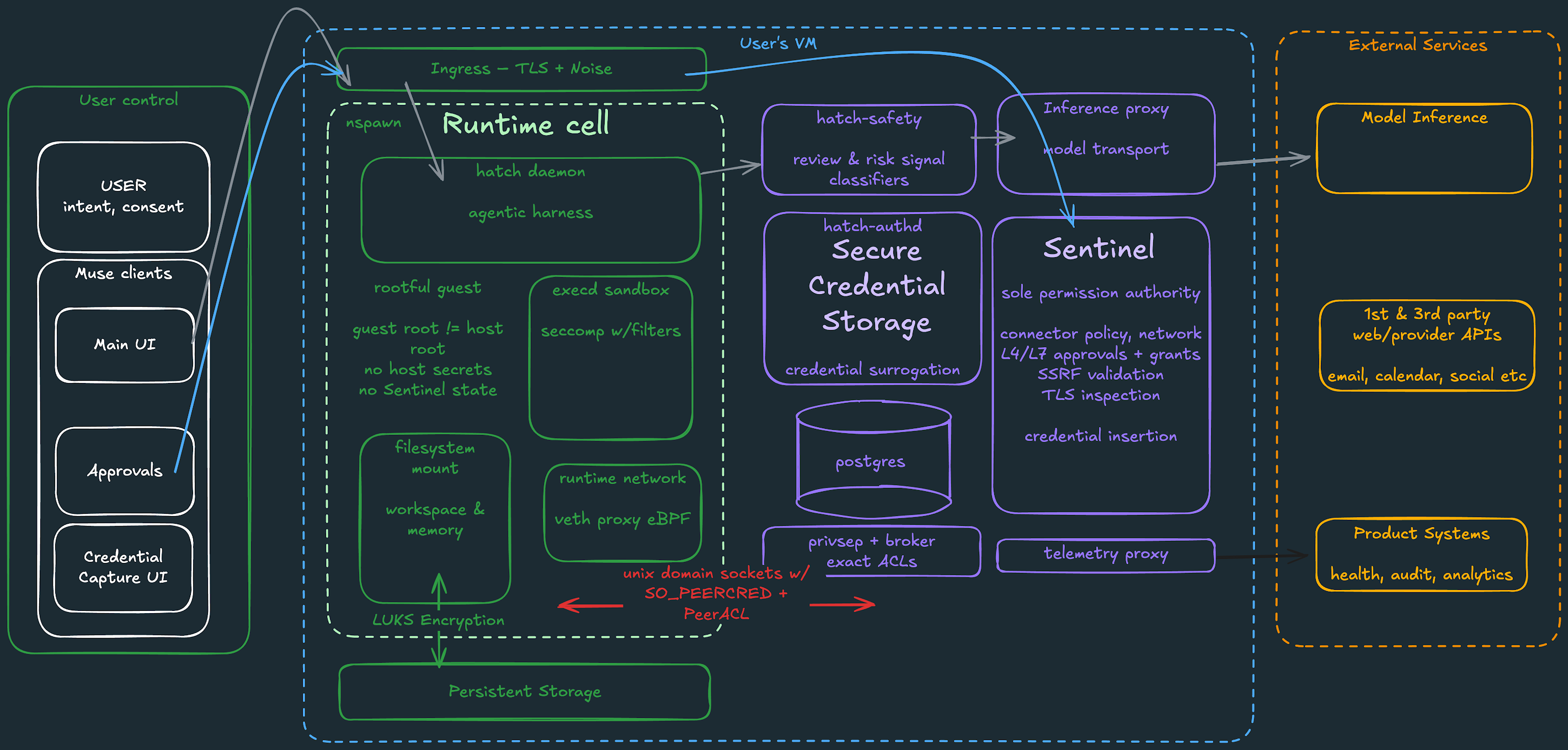
Meta Muse runs in the US and Canada only, the Meta Model API behind it ships with no data processing agreement and no EU residency, and the Confidential VM promised for later this year does not settle who the GDPR controller is. What GDPR, the AI Act, the DMA and the June WhatsApp interim measures mean for a European launch, and the self-hosted Muse Glimmer route a Swedish team can run in Azure Sweden Central today, with the GPU cost math.
Microsoft's AI code of conduct: what it does not cover
Microsoft AI published a draft Humanist AI Code of Conduct on 14 September 2026, committing its MAI models to absolute constraints on weapons, offensive cyber operations and resistance to shutdown, under a chain of command that operators and users cannot override. The scope line matters more than the constraints: the Code does not extend to third-party models Microsoft merely hosts, so GPT-5.6 in Microsoft 365 Copilot and Claude in Foundry sit outside it.
GPT-6 Astra in Foundry: the price, the gate and the EU gap
GPT-6 Astra arrived in Microsoft Foundry on 3 September 2026 at $10/$50 per million tokens, the same list price as Claude Fable 5.1 and 2.5x GPT-5.6 Sol on promo, behind a Limited Access gate and with no EU Data Zone. The cost math on document jobs and 60-turn agent loops, the 272K long-context cliff, what the Critical cyber rating means for refusals, and how a Swedish team should handle residency until the EU zone lands at its new 20% premium.
Claude Fable 5.1 in Foundry: cache math and the EU caveats
Claude Fable 5.1 keeps Fable 5's $10/$50 pricing but cuts cache reads to $0.25 per million tokens, which turns a 60-turn agent session from $17.25 into $10.50 and shrinks the premium over Opus 5 from 2x to about 22%. On Microsoft Foundry it ships Anthropic-hosted only, with no EU data zone, no Batches API, a zero default quota on pay-as-you-go, mandatory 30-day retention until Enterprise Frontier Safeguards arrive, and three breaking changes for teams migrating from Fable 5.
A classifier is not a sandbox: isolating coding agents
A published attack chain achieved remote code execution against Claude Code in auto mode, with the safety classifier approving the steps that led to compromise and then blocking the cleanup command. What the break teaches teams running AI coding agents, and how to build real isolation on Azure with Hyper-V sandboxes, default-deny egress and short-lived credentials.
Claude's text watermark: what it means for Article 50
Anthropic will weave an invisible watermark into Claude's text output to meet the EU AI Act's Article 50 marking obligation, applying it globally across the API, apps and cloud platforms including Microsoft Foundry. What the mark can and cannot prove, which deployer duties remain yours, and when a DIY provenance layer still earns its keep on Azure.
Unlimited free ChatGPT vs governed enterprise AI on Azure
OpenAI removed limits on text chats for free ChatGPT users on 6 August 2026 and made GPT-5.6 Luna the default, cutting factual errors by roughly 62 percent versus the prior model. For Swedish and EU enterprises on Azure, the free consumer tool employees already use just became unlimited and much stronger, so shadow AI pressure rises and the case for a governed answer built on Copilot Chat, paid Copilot seats and Azure OpenAI becomes urgent.
Who enforces the AI Act in Sweden? PTS and the new map
Sweden's AI Act enforcement map is now set: the SOU 2025:101 inquiry designates Post- och telestyrelsen (PTS) as coordinating market surveillance authority, with eleven surveillance bodies, two notifying authorities, and a PTS-run regulatory sandbox. The supplementary law was written to take effect on 2 August 2026 but awaits formal adoption, so PTS and its peers operate on interim government assignments while EU transparency rules already apply.
AI Act enforcement is now real: an Azure deployer checklist
On 2 August 2026 the European Commission's enforcement powers over general-purpose AI providers activated: the AI Office can now demand documentation, run model evaluations, restrict models from the EU market and fine up to 3% of global turnover or EUR 15 million. The same date brought Article 50 transparency into application, and this guide maps what Azure OpenAI and Foundry teams must demand from vendors versus handle themselves as deployers.
Kimi K3 open weights: the EU self-hosting reality check
Moonshot AI published Kimi K3's open weights on 26 July 2026: a 2.8-trillion-parameter mixture-of-experts model with a 1M-token context window, shipped in MXFP4 under a custom licence that gates large-scale commercial inference. We work through the licence terms, the GPU memory and cost math for serving it in an EU Azure region, and a decision framework for choosing between self-hosting, a managed API and a smaller single-node open model.
The AI Act's high-risk deadline moved to December 2027
Regulation (EU) 2026/1744, the Digital Omnibus on AI, entered into force on 27 July 2026 and moves the AI Act deadline for Annex III high-risk systems from August 2026 to 2 December 2027, with Annex I embedded systems following in August 2028. Article 50 transparency still applies from 2 August 2026, a new prohibition arrives with a December 2026 marking deadline, and a phased 16-month plan turns the reprieve into a workable compliance programme.
Sovereign AI on Azure: what the Microsoft-Mistral deal means
Microsoft and Mistral announced an expanded partnership on 21 July 2026: Mistral Medium 3.5 and OCR 4 arrive in Microsoft Foundry and Copilot Studio, deployable from Azure cloud to customer-controlled and fully air-gapped Azure Local environments, backed by a multibillion-dollar European GPU buildout. We compare the three deployment modes and what each one solves for Swedish public sector and regulated industries.
Article 50 compliance for Azure OpenAI apps: a guide
The European Commission adopted its final Article 50 transparency guidelines on 20 July 2026 and confirmed the Code of Practice on marking AI-generated content as adequate, less than two weeks before the obligations start to apply. Here is what Swedish and EU teams running chatbots, copilots and content generators on Azure OpenAI must implement: chatbot disclosure, machine-readable marking and deepfake labels, with concrete code patterns for each.
AI Act deadlines moved: what still lands August 2, 2026
On 16 June 2026 the European Parliament approved the Digital Omnibus amendments 423-57, moving Annex III high-risk AI Act obligations to 2 December 2027 and product-embedded obligations to 2 August 2028. Article 50 transparency duties and the Commission's GPAI enforcement powers were not delayed, which leaves Swedish enterprises six weeks to ship chatbot disclosure, content marking and a documented GPAI position before 2 August 2026.
Who will knock on your door about AI in Sweden? IMY, mostly
On 15 June 2026 IMY confirmed its role as market surveillance authority for the EU AI Act, with responsibility covering AI systems in areas such as law enforcement and credit assessment, alongside PTS and Finansinspektionen. For Swedish enterprises this puts GDPR and AI Act supervision under one regulator, and IMY's sandbox role offers a way to get data protection guidance before enforcement reaches full strength in 2027.
Gemini Enterprise Agent Platform vs Azure AI Foundry
Google's I/O 2026 enterprise announcements, led by the Managed Agents API, Gemini Spark and Gemini 3.5 Flash, take direct aim at Azure AI Foundry Agent Service and the Copilot ecosystem, down to launch connectors for SharePoint and OneDrive. For Azure-first Swedish and EU teams the decision rests on four questions: where the data lives, whether the cost claim survives real traces, whether audit obligations can be met, and what a second platform costs.
Gemini 3.5 Flash vs GPT-5.5 vs Claude Opus 4.7 at I/O 2026
Google shipped Gemini 3.5 Flash on day one of I/O 2026, the third frontier agentic coding model in five weeks after Claude Opus 4.7 and GPT-5.5, alongside a $100/month developer tier and the Antigravity 2.0 agent platform. For Azure-first teams the practical response is a reusable evaluation harness and a documented cost comparison for renewal leverage, not a migration.
EU AI Act High-Risk Readiness: 11 Weeks to August 2026
High-risk obligations under the EU AI Act apply August 2, 2026. For teams shipping AI inside the Annex III categories, that is 11 weeks of runway. This is the readiness state most teams reach by skipping the strategy decks: what actually changes, what the four obligations that require code look like, and where compliance spending misfires before the deadline.
Demystifying the EU AI Act: The Engineering Reality
A working-engineer walk-through of the EU AI Act beyond the risk-tier summary. Covers legal structure, Annex III classification decisions, GPAI rules, the full timeline to 2027, Article 12 logging, Article 50 transparency, conformity assessment artifacts, CE marking, penalties, and the Swedish implementation.
EU AI Act High-Risk: Swedish Prep for December 2027
The Digital Omnibus on AI moved the Annex III high-risk deadline from 2 August 2026 to 2 December 2027, and Annex I embedded systems to 2 August 2028. Article 50 transparency, the Article 5 prohibitions and the general-purpose AI duties did not move, so this is the Swedish prep list rewritten around what is already enforceable and how to spend the runway that is left.
EU AI Act One Year On: Lessons for Swedish B2B Teams
A practical review, one year after the EU AI Act Article 5 prohibitions entered into force on 2 February 2025 — where Swedish B2B teams over-reacted, where they under-reacted, and what must ship before the August 2026 high-risk deadline.
Compliance as Competitive Advantage: AI Governance With Microsoft Purview - Microsoft Ignite 2025
Microsoft Ignite BRK270: Transform compliance from burden to accelerator. Microsoft Purview, Compliance Manager, AI Baseline, Regulatory Navigator. Automated governance for GDPR, AI Act, NIS2. 3-5x faster deployments, 70-90% less audit time.
End-to-End Security for AI Platforms, Apps, and Agents - Microsoft Ignite 2025
From assistive copilots to autonomous digital workers, AI presents unprecedented security challenges. Discover Microsoft's comprehensive approach to securing AI platforms, apps, and agents with Agent 365, Entra Agent Identity, Purview data governance, Defender security posture, Sentinel threat detection, and EU AI Act compliance automation.